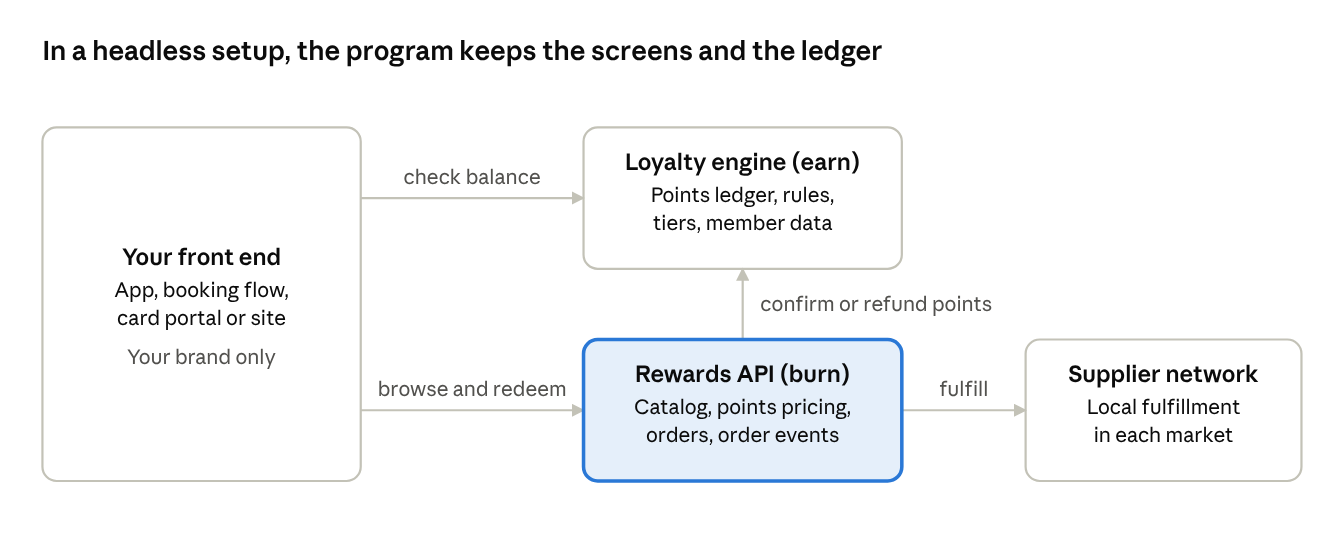
A rewards API gives a loyalty platform, app or agency stack a full redemption layer through one integration: a catalog of rewards, live pricing in points, checkout, and fulfillment across markets. It sits behind the earn engine that tracks points, and in a headless setup the program keeps its own front end and its own brand.
Loyalty technology has spent a decade getting very good at earning consumers reward currency in some form. Modern loyalty engines expose clean APIs for accrual rules, tiers, promotions and the points ledger, and most product teams now treat that layer as solved infrastructure.
But redemption hasn’t had the same attention. In many programs, the burn side of the customer experience is still a hosted catalog located on a subdomain, with a patchwork of single-category merchandise supplier feeds, or a gift card link dropped into an email.
Members notice this disconnect.
An early look at Bond’s 2026 Loyalty Report, covered by The Wise Marketer, found that 28% of Canadian members redeem once a year or less.
Over the same year, the share who rate ease of receiving and claiming rewards as important rose from 69% to 73%. Demonstrating that friction often sits at redemption, not enrollment.
That’s an odd place for a gap, as redemption is the moment a program says thank you, and it’s the moment that makes a member want to earn again (and again, and again).
So burning rewards drives earning behaviors.
If you own the redemption roadmap at an airline, hotel group, bank or retailer, the questions about the redemption layer are both technical and commercial at once.
This article covers what a rewards API should do for a loyalty program, what changes when redemption goes headless, and where building it yourself stops making sense.
Which APIs does a loyalty program need?
Most loyalty programs can run on three kinds of API. Universally, a loyalty engine handles earn: the points ledger, rules, tiers and member data. Then, either multiple single-category supplier APIs each deliver one type of reward (such as gift cards, hotel nights or merchandise) or a rewards marketplace infrastructure can deliver the whole burn side through one integration. This can include a multi-category catalog, pricing, checkout and global fulfillment across markets.
Layer
What it does
Examples
Earn or burn
Where it runs out
Loyalty engine
Points ledger, accrual rules, tiers, promotions, member profiles
Built to sit behind your loyalty engine, not replace it. Earn tools are an optional extra for programs that need them
The confusion usually starts with the word “rewards.” Ask an engineer to find a rewards API and they’ll come back with one of two things: a loyalty engine with a rewards object in its schema, or a gift card API.
Both are useful, but neither gives a frequent flyer in Dubai a choice of a local spa day, headphones priced in dirhams, a hotel night nearby and a charity donation, all inside the airline’s own app.
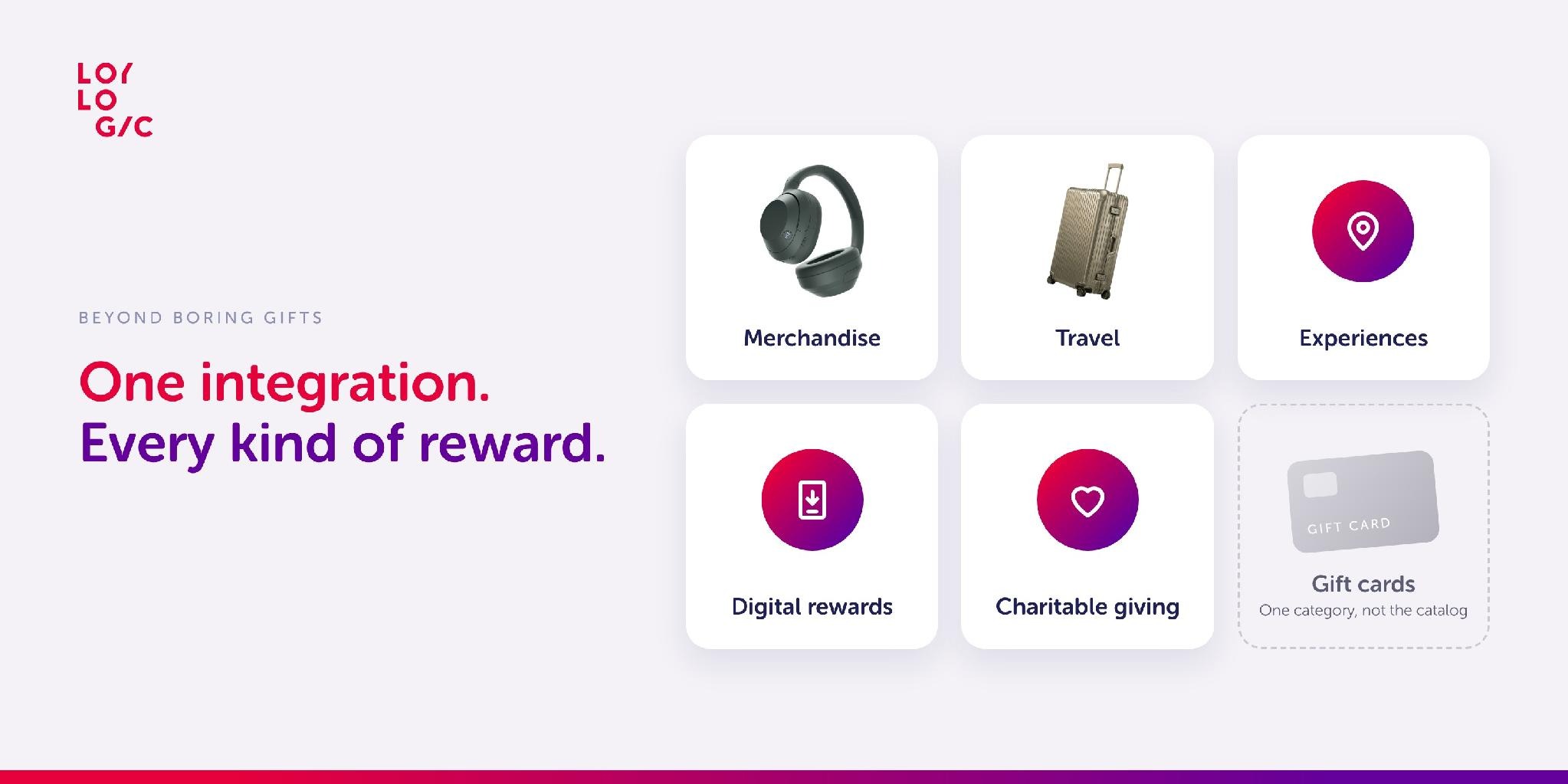
Gift cards deserve a specific word, because they’re where most teams start. They’re a perfectly good category inside a catalog, and some members want exactly that. As the whole redemption offer, though, they’re the lazy friend: generous on paper, and indistinguishable from a cashback scheme that skipped the loyalty part. A rewards API for a loyalty program should treat gift cards as one category among many, not as the catalog.
What is a headless rewards API?
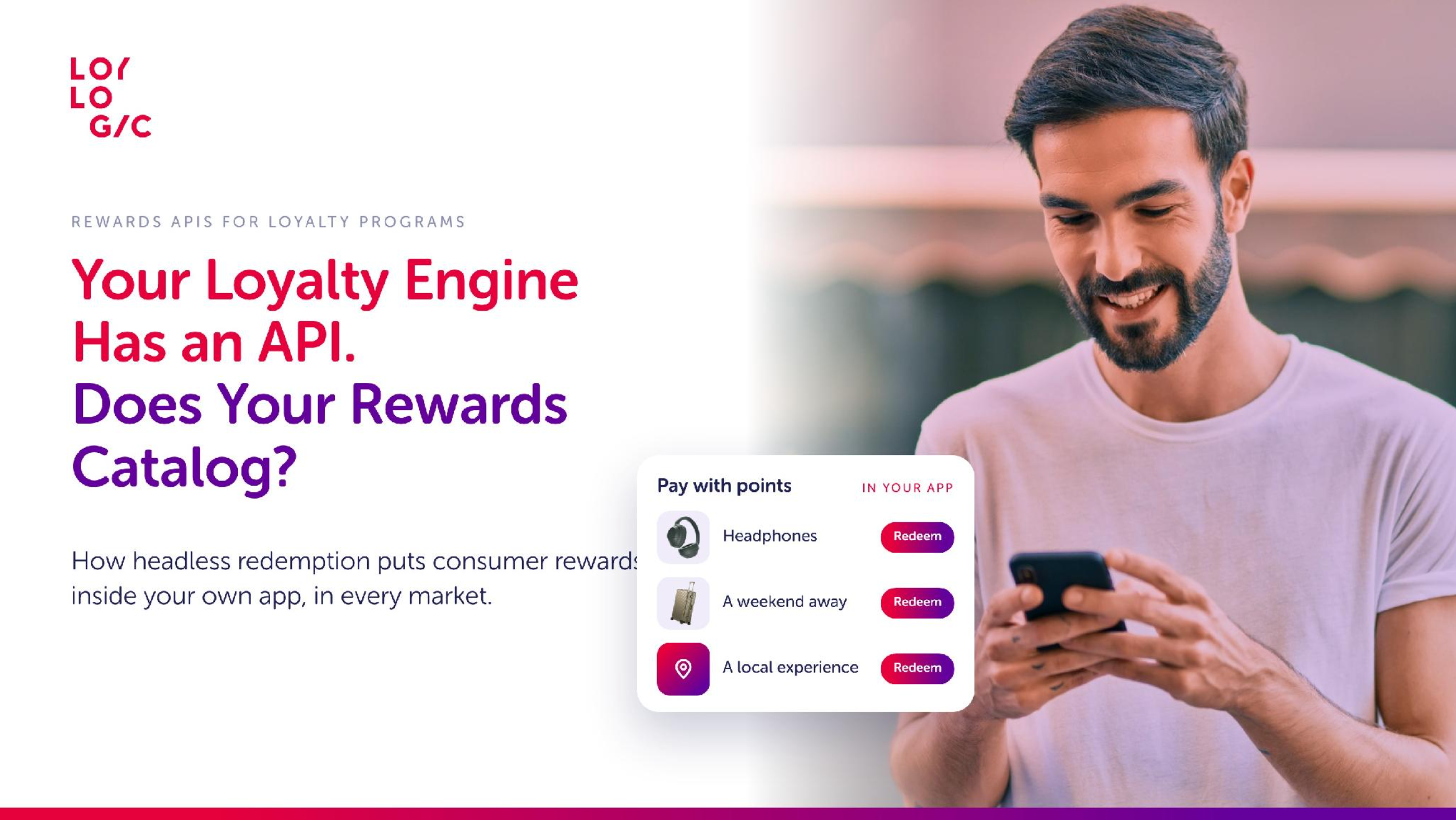
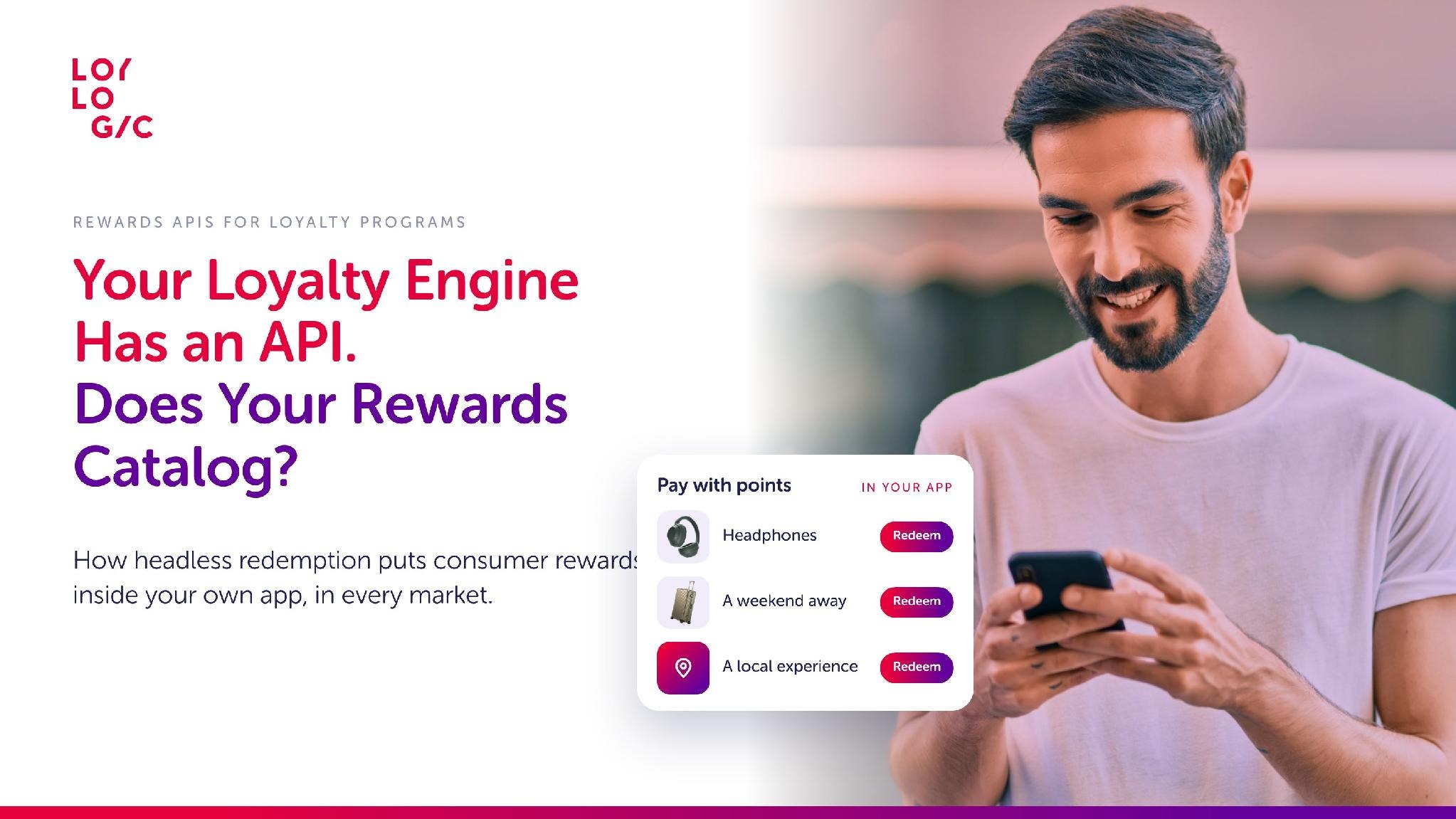
A headless rewards API separates the redemption engine from the screens members see. Catalog, pricing, orders and fulfillment run as services, and the program builds its own front end on top, so members never leave the brand and the experience is seamless.
The alternative is a hosted storefront: a branded catalog site the rewards provider runs, linked from the program with single sign-on. Hosted is often a quick first step when getting going.
Headless is what you choose when redemption has to happen inside a journey you already own.
That’s where the commercial case gets interesting. Here’s a few examples of what headless makes possible in loyalty schemes:
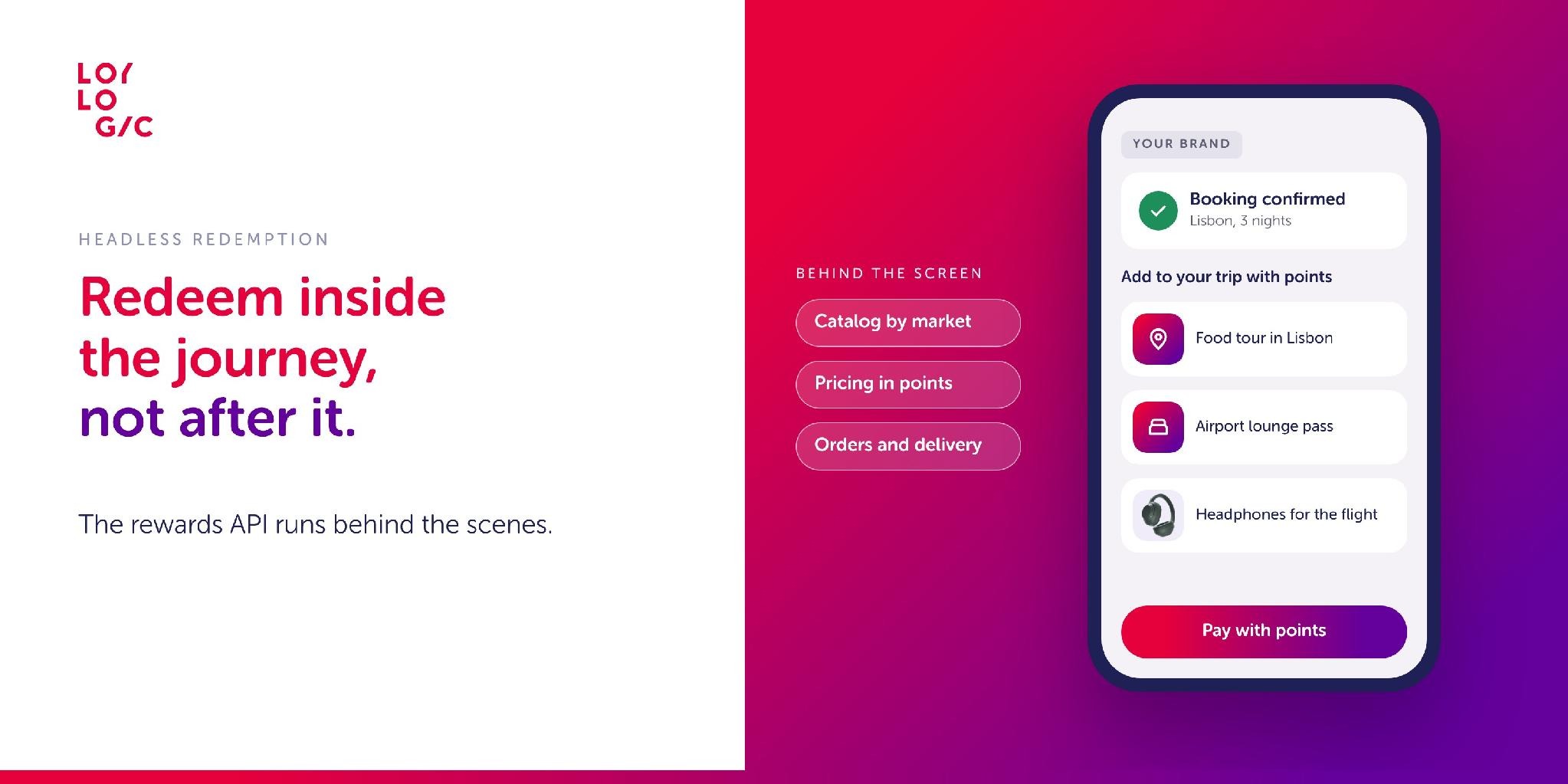
An airline offers seat upgrades, lounge passes and destination experiences on the booking confirmation screen, priced in miles, instead of sending members to a separate shop after the trip.
A bank lets cardholders pay with points at the moment of checkout in its app, with points-plus-cash when the balance falls short, rather than asking them to browse a catalog they’ll forget about.
A hotel group puts local experiences next to the stay, so a member booking three nights in Lisbon sees a food tour and evening entertainment in that city, not a generic list of global vouchers.
A loyalty SaaS platform adds a native rewards tab to every client program it runs, branded per client, without building a supply chain behind it.
None of these needs a new loyalty engine. The earn side keeps the ledger and the member profile.
The rewards API answers three questions on demand: what can this member redeem here, what does it cost in their points, and has it been delivered yet?
The loyalty engine stays the system of record for points. The rewards API handles everything between “redeem” and “delivered.”
What should a rewards API do for a loyalty program?
A rewards API for loyalty should return a catalog filtered by market and member, price every item in the program’s own points currency, support pay-with-points and points-plus-cash, manage the full order lifecycle with status events, handle cancellations and point refunds cleanly, and send redemption data back so the catalog gets more relevant over time.
Most API comparisons stop at “has REST endpoints” and “has docs.” For a loyalty program, the questions that really matter sit one level down.
Capability
Why it matters in a loyalty program
Question for the provider
Market-aware catalog
A member in Riyadh and a member in Manchester shouldn’t see the same list. Availability, brands and delivery options differ by country.
“If I query the catalog for a member in Saudi Arabia, what’s excluded, and why?”
Pricing in your points currency
Members compare reward prices with local retail. Points that look marked up erode trust in the whole program.
“How is the points price set per market, and how often is it updated when exchange rates move?”
Flexible payment
Pay-with-points, points-plus-cash and partial redemptions turn “I don’t have enough” into a purchase.
“Can a member top up a shortfall with a card, and who holds the payment risk?”
Order lifecycle and events
Members expect the same status updates they’d get from any online shop. Your support team needs them too.
“Which order events do you push to us, and what happens if our endpoint is down?”
Cancellations and point refunds
A failed delivery that doesn’t return points is a complaint waiting to happen, and a ledger mismatch for finance.
“Walk us through a canceled order, from your system to our ledger.”
Content you can brand
Headless only works if images, descriptions and terms arrive clean, translated and ready to render in your design system.
“Which languages do you supply product content in, and who maintains it?”
Curation and personalization
A catalog of millions is only useful if each member sees the few hundred that fit them.
“What signals do you use to curate, and who signs off on what members see?”
Security and data handling
A redemption carries a name, an address and sometimes a payment. That’s personal data crossing a system boundary.
“What member data do you need per order, where does it sit, and for how long?”
Reporting
Redemption behavior is some of the best intent data a program owns. It shouldn’t be stuck in a supplier portal.
“Can redemption data flow into our own analytics and our loyalty engine?”
The curation row is the one most teams underweight. Breadth matters, but only as raw material.
The real job is narrowing a huge supply base to the rewards a specific member is likely to want, in their market, at the moment they’re ready to redeem.
That’s where AI earns its keep. It might spot that frequent business travelers in one region redeem lounge access and tech while leisure members redeem experiences, and adjust what each group sees.
People still need to own the result. AI gives you reach, and your team brings the judgment about what fits the brand.
How does rewards API integration work with a loyalty platform?
Integration links the loyalty engine’s points ledger to the rewards API’s catalog and orders. The program decides which system holds the ledger, maps its points value in each market, queries the catalog, places orders when a member redeems, listens for fulfillment events, and reconciles points and orders on a schedule.
Surface decisions such as these early, while they’re still cheap to fix.
Decide who owns the ledger. In almost every loyalty program, the loyalty engine stays the system of record for balances. The rewards layer should never hold a second copy of the truth. Settle this first, because every later step depends on it.
Map your points value by market. Agree how one point converts into each local currency, and who updates that when currencies move. This is a commercial decision as much as a technical one, and it shapes how generous the program feels.
Choose how you’ll read the catalog. Live queries keep prices and availability current. A cached sync is faster to render. Most programs use both, caching the browse experience and checking live at checkout.
Design checkout as a two-step commit. Hold the points, place the order, then confirm the deduction when the order is accepted. If the order fails, release the hold. Use idempotency keys so a retry on a slow mobile connection doesn’t create two orders.
Subscribe to order events. Shipped, delivered, voucher issued, booking confirmed, canceled. Push them into the member’s app and your support tools, so nobody has to email a supplier to find a parcel.
Handle the unhappy paths. Out-of-stock after payment, a failed delivery, a return, a booking change. Each one needs a defined route back to the ledger.
Reconcile daily. Compare points deducted with orders fulfilled. Finance will ask, and so will your auditors, especially if the program carries points liability on its balance sheet.
Close the loop. Send redemption data back to the loyalty engine and your CRM. What members choose tells you more about them than most surveys will.
Be sure to test with your hardest market, not your home market. That’s where catalog gaps, delivery times and translation problems show up.
Should you build rewards infrastructure in-house?
It’s tempting to build in-house, and for a small number of programs it can be the right call. If you run in one or two markets with a narrow catalog that rarely changes, building a reward catalog in-house can work. But beyond that, connecting to an API is the easy part. The hard part is running everything behind it, in every market, for as long as the program exists: suppliers, content, pricing, tax, fulfillment and service.
Engineering teams tend to scope a rewards build as an integration project. Connect a few suppliers, build a catalog service, add checkout. It looks like a quarter’s work. But what that estimate leaves out is the operating business underneath.
Someone has to negotiate and renew supplier contracts in every market, and keep product content accurate in every language. Someone else has to reprice when costs and exchange rates move, chase a parcel stuck in customs, handle a return in Brazil, and replace the electronics brand that just exited a market.
None of it is a one-off build. It very quickly evolves into a permanent operation, which grows with every new country the program enters.
Plus, every sprint spent on supplier plumbing is a sprint not spent on enhancing the earn engine.
There are exceptions of course. A grocery retailer redeeming points against its own shelves doesn’t need an external catalog, and neither does a single-market coalition with a fixed partner list.
We walk through the same trade-off in this Build vs Buy article on LinkedIn.
Where Loylogic fits in a loyalty stack
Loylogic is white-label rewards marketplace infrastructure that sits behind loyalty engines, agencies and enterprise programs, and supplies the catalog, pricing, checkout and fulfillment through one integration, in 190+ countries and from 150+ suppliers. Members only ever see the program’s brand.
Programs connect in one of three ways, set out on our enterprise integration page:
Option
What you get
Time to market
Plug-and-Play
A ready-made rewards experience using Stars, a predefined reward currency
2 to 5 days
Enterprise
A managed, configured deployment using your own points currency and branding
2 to 4 weeks for programs, 1 to 2 weeks for campaigns
Headless API
Catalog, pricing, orders and fulfillment as services, embedded in your own app, portal or booking flow
Defined by your build
A program can start on one model and move parts of the journey headless later. Programs that already run a loyalty engine keep it. Programs without one can add optional earn-side modules, such as Currency & Wallet and Behavioral Activation.
Either way, the supplier, pricing and fulfillment work described above sits with us, not with your engineering team.
Frequently asked questions
What is a rewards API for loyalty programs?
A rewards API lets a loyalty program offer redemption through its own systems. It exposes a catalog of rewards, prices them in the program’s points currency, takes orders when members redeem, and handles fulfillment and delivery updates. It works alongside the loyalty engine, which keeps track of the points.
What’s the difference between a loyalty API and a rewards API?
A loyalty API, sometimes called a loyalty program API, manages earn: the points ledger, accrual rules, tiers, promotions and member profiles. A rewards API manages burn: what members can redeem, what it costs in points, and how it’s delivered. Most programs need both, connected so a redemption deducts points in the loyalty engine and creates an order in the rewards layer.
What is a headless rewards API?
A headless rewards API provides redemption as services without a fixed front end. The program builds its own screens, in an app, a booking flow or a member portal, and calls the API for catalog, pricing, orders and fulfillment. Members redeem without leaving the brand’s experience.
Which rewards platforms offer API integration for loyalty programs?
Loyalty engines such as Epsilon, Talon.One, Voucherify, Antavo and Open Loyalty offer APIs for the earn side. For the burn side, rewards marketplace infrastructure such as Loylogic offers a headless API for multi-category redemption across 190+ countries, alongside managed and plug-and-play options. Single-category supplier APIs cover individual reward types such as gift cards.
What’s the best rewards API for a loyalty program?
The best loyalty rewards API is the one that fits your earn engine and your markets. Look for a catalog filtered by country, pricing in your own points currency, pay-with-points and points-plus-cash, order events, clean point refunds, white-label content and redemption data you can use. For multi-category redemption across many countries, rewards marketplace infrastructure such as Loylogic covers the burn side behind any loyalty engine.
Is a rewards API the same as a gift card API?
No. A gift card API delivers one reward type. A rewards API for loyalty covers the whole redemption offer, which can include merchandise, travel, experiences, digital rewards, charitable giving and gift cards, priced in points and fulfilled locally. Gift cards work well as one category in that catalog, but rarely as the whole offer.
How do loyalty SaaS platforms add rewards capabilities?
The fastest route is to connect to rewards infrastructure rather than build a supply chain. The platform keeps the points ledger and member data, and calls a rewards API for the catalog, pricing, orders and fulfillment. Each client program can then be branded separately, with a catalog configured for its markets and members.
Which APIs offer global rewards catalogs?
Rewards marketplace infrastructure providers offer global catalogs through a single API. Loylogic’s Global Rewards Marketplace covers 190+ countries, 100+ reward categories and 150+ suppliers, with catalogs curated by market and audience. When comparing providers, check in-market fulfillment for your priority countries, not just which countries a catalog ships to.
How long does a rewards API integration take?
It depends on the model. With Loylogic, a plug-and-play setup can launch in 2 to 5 days and a managed enterprise deployment in 2 to 4 weeks. A headless integration runs on your own build timeline, driven mostly by how you handle checkout, order events and reconciliation with your loyalty engine.
Most Loyalty Reward Catalogues Fail to Drive Repeat Custom: Here’s What Providers Can Do About It
Every loyalty agency and platform provider has had this conversation with a client. The program is enrolling members, the tech is working fine, and all the dashboards look healthy. Yet this still isn't translating into the repeat customer behavior everyone promised.
Insights & Thought Leadership
Jul 31, 2026
4
min
Beyond Points and Discounts: Six Trends Shaping the Future of Rewards in the UK
As loyalty matures, UK organizations are moving from static reward catalogs to intelligent, flexible, and scalable rewards infrastructure.
Pricing Strategy
Jul 7, 2026
14
min
Middle East loyalty trends 2026: Six forces shaping customer engagement
For years, loyalty programs across the region operated on a simple formula: spend more, earn more. Points, vouchers, cashback, and discounts became the currency of customer retention.
Insights & Thought Leadership
Accelerate your growth through our rewarding experiences
Get in touch for a personalized demo and see how our reward solutions can help your business grow.