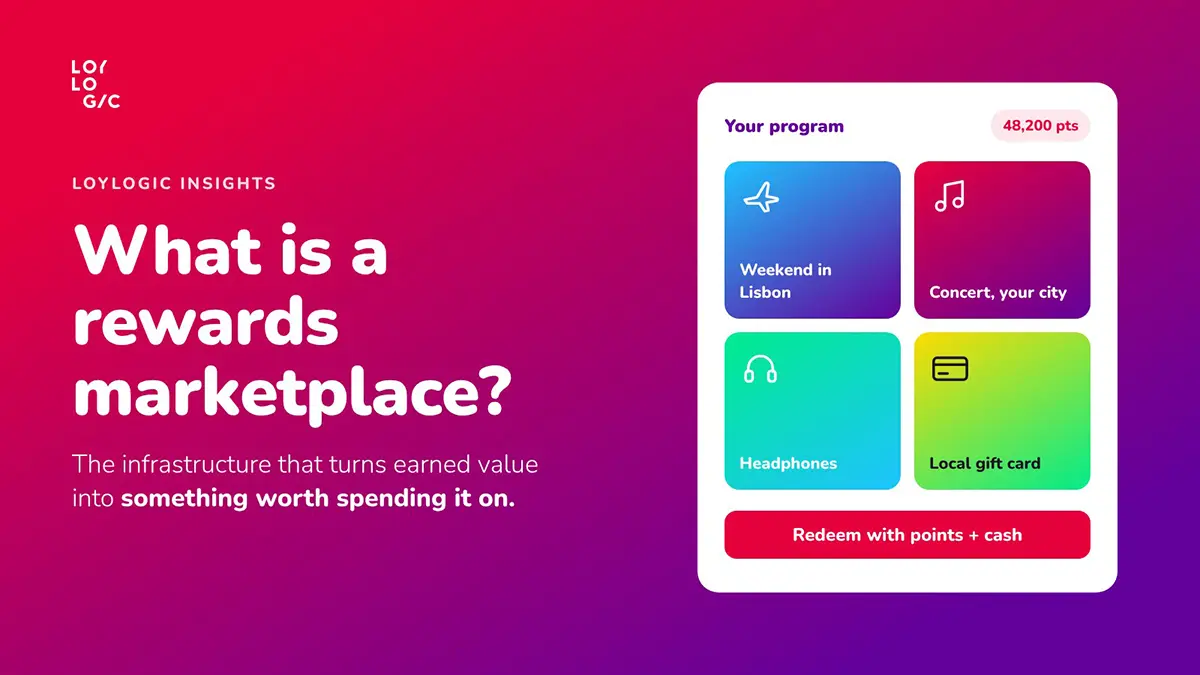
A rewards marketplace is the infrastructure that turns the value a loyalty, recognition or incentive program has given out into something a member wants to spend it on. It combines a curated catalog, the supplier network behind it, pricing, checkout and fulfillment, and it runs behind the program's own brand and earn engine.
That's the short answer. The longer one matters more, because the term now gets stretched to cover cashback apps, gift card APIs and the catalog tab inside an HR platform. All of them let someone swap value for a reward. But they don't solve the same problem, and a program that buys the wrong one tends to find out at redemption time, when members log in, scroll for a minute and leave with their points unspent.
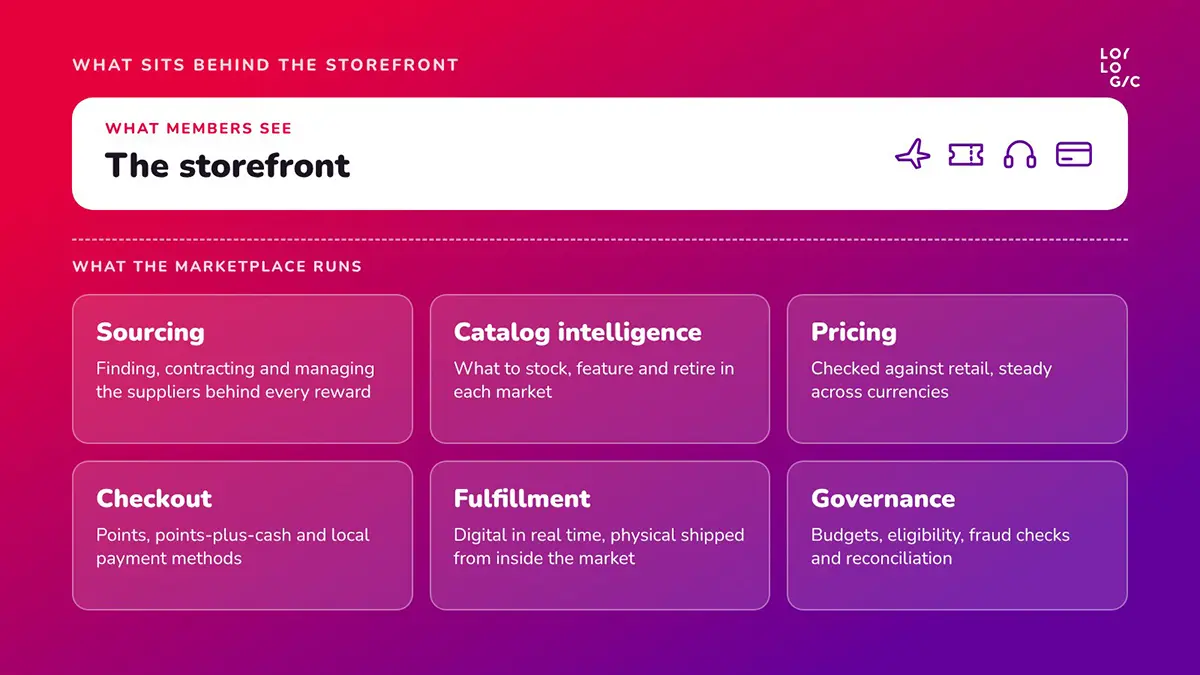
What sits behind the storefront
The storefront is the part everyone sees at the front end, and it's typically the easy part, as most of the work involved in a rewards marketplace happens where members never look. Challenges include:
Sourcing and supplier management. Someone has to find, contract and keep an eye on the brands, distributors, travel providers and gift card issuers behind every reward, then replace them when they underperform.
Catalog intelligence.Deciding what to stock in each market, what to feature for which audience, and what to retire because nobody redeems it. A catalog that never changes goes stale within a season.
Pricing. Members compare. If a pair of headphones costs 40,000 points and the same model is on sale for noticeably less at a major retailer that week, the member does the math and the program looks mean. Prices need checking against the open market, and point values need to hold steady across currencies.
Checkout. Pay with points, points-plus-cash for members whose balance falls short, local payment methods for the cash part, and a flow that doesn't feel like a 2009 intranet.
Fulfillment. Digital rewards delivered in real time. Physical rewards shipped from inside the market where possible, because a product that's a sensible reward in Germany can come with import duty, a three-week delivery window or the wrong plug in Saudi Arabia.
Governance. Budgets, eligibility rules, fraud checks, reconciliation, and the reporting finance will ask for.
That's why programs rarely build this themselves anymore.
Running one reward catalog in one country is manageable. Running it across a dozen markets, with hundreds of suppliers and prices that move every week, is a business in its own right.
Marketplace, catalog, gift card API or recognition platform?
These four get lumped together as if they were interchangeable. However, they're built for different jobs.
Static reward catalog
Gift card or payout API
Recognition platform catalog
Rewards marketplace
Built for
A fixed list of rewards for one program
Sending digital value fast
Employee appreciation workflows
Running redemption at scale, across markets and audiences
Reward range
Whatever was sourced at launch
Gift cards, prepaid cards, cash
Bundled catalog, often gift-card heavy
Merchandise, travel, experiences, gift cards, subscriptions, charity
Local relevance
Usually one market
Depends on brands available per country
Varies
Curated per market and audience
Pricing
Set once, then drifts over time
Face value
Set by the platform
Monitored against retail and FX
Whose brand
The program's
Often the provider's
The platform's
The program's, or the partner's
Fulfillment
Managed supplier by supplier
Digital only
Handled by the platform
Orchestrated end to end, physical and digital
A gift card API is a perfectly good way to pay out a survey incentive or a referral bonus. A recognition platform makes sense when the workflow is the product.
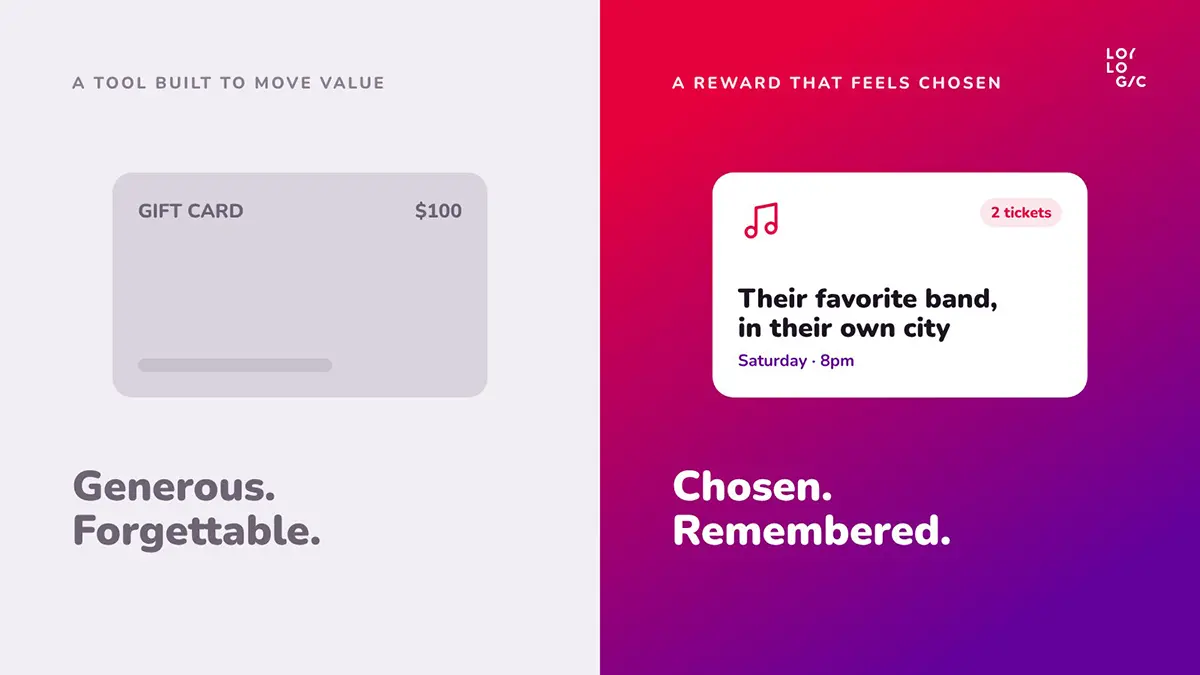
The trouble starts when a program that wants members to feel truly appreciated settles for a tool built to shift value.
Picture a close friend's 50th birthday: you stand up, say something heartfelt, and hand over a generic gift card. Generous, sure. But the moment falls flat.
Programs do the same thing every day, at the exact point where gratitude is meant to land. A marketplace exists to make that moment feel chosen.
Where it sits in the loyalty stack
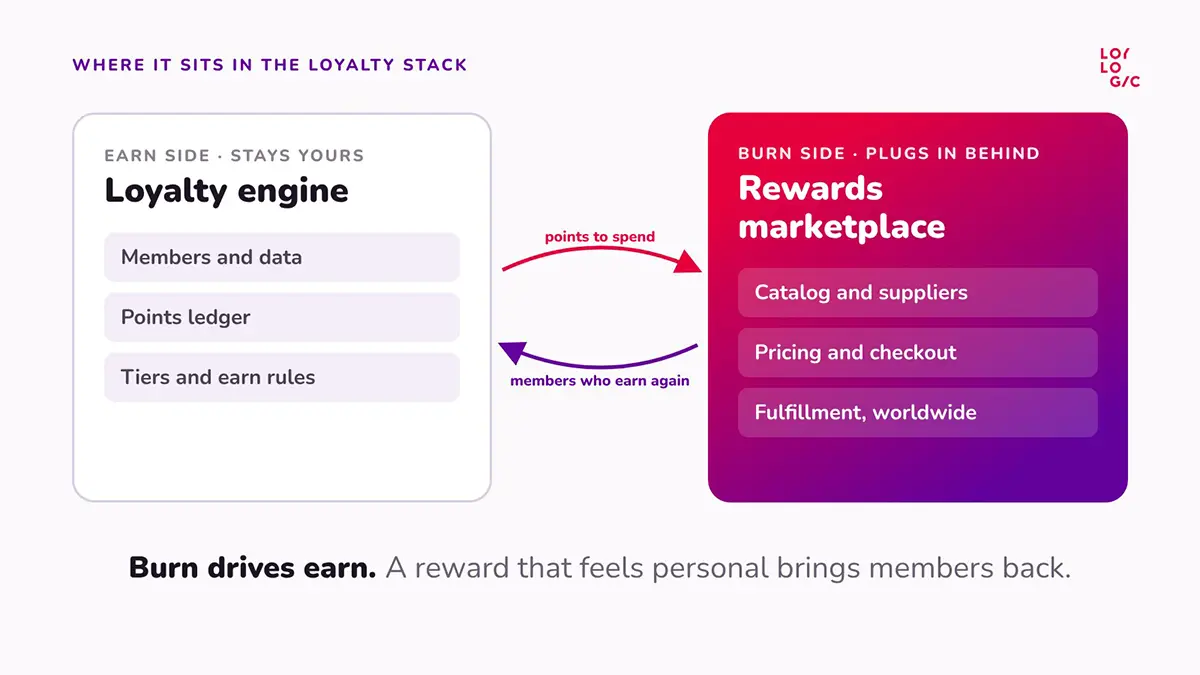
You can think of a program in two halves.
The earn side decides who receives value and why: that's the loyalty engine, the member data, the ledger, tiers and rules. The burn side decides what that value turns into. A rewards marketplace is burn-side infrastructure, and it's designed to plug in behind whatever runs the earn side.
That placement is the point.
Because the marketplace sits behind the earn side, nobody has to replace what they already run. An airline carries on using its own loyalty platform and award-flight booking. An agency holds on to its client relationships and the programs it designs. A loyalty SaaS provider keeps selling its own product. The marketplace plugs in behind each of them, as a ready-made storefront or through an API, and takes care of the catalog, the suppliers and the delivery.
It's also why the burn side deserves more attention than it usually gets.
A member redeems, the reward feels personal, their attachment to the program grows, and they start earning more deliberately. Burn drives earn, and the research backs it: a 2024 study in the Journal of Service Research found point redemption is a useful way to win back customers who are drifting away. A program that underinvests in redemption ends up with a liability on the balance sheet and members who've stopped paying attention.
Some marketplaces (such as ours) now offer earn-side tools too, such as a ready-made reward currency or campaign mechanics, for programs that don't have an engine of their own or want to launch fast.
What to look for when you choose one
Most provider websites quote similar numbers, so the useful questions when conducting your research are those that scratch beneath the surface, such as:
How deep is the range, beyond gift cards? Gift cards are the easiest category to source and the easiest to commoditize. Look at travel, experiences, local brands and anything members can't simply buy elsewhere at the same price.
How are prices kept honest? Ask how often prices are checked against retail, and how point values are held steady when exchange rates move.
Whose brand does the member see? The storefront, the emails and the order confirmation should feel like your program, or your client's.
How is the catalog curated? AI can sort millions of options down to what each market and segment is likely to want. People still need to make the commercial and brand calls. So ask who does what.
Who owns the problems? Returns, a supplier that goes under, a package stuck in customs, a member calling about a missing voucher. These are the moments that decide whether a program team sleeps at night.
Will they compete with you? For agencies and platforms, this one matters most. A good marketplace partner stays behind the scenes while your brand takes the lead (and doesn't pitch your clients).
Where Loylogic fits
Loylogic has been building rewards marketplace infrastructure since 2005, and today runs the Global Rewards Marketplace behind loyalty, recognition and incentive programs. It covers 190+ countries, with 100+ reward categories from 150+ global suppliers, including 2,000+ gift cards and 1,000+ experiences, totaling 15 million+ reward options, on a platform with 99.5% availability.
Programs connect in one of three ways.
Plug-and-Play launches a branded Stars Shop in 2 to 5 days.
Enterprise puts the program's own currency, rules and branding on a Loylogic front end in 2 to 4 weeks.
The Headless API embeds the marketplace inside the program's own app or platform, on whatever timeline that build needs.
The burn side is the core of what Loylogic does. Optional modules such as Currency & Wallet and Behavioral Activation are there for programs that need an earn engine or want to add campaigns, and they're built to sit alongside a partner's platform rather than replace it.
A rewards marketplace is the infrastructure a loyalty, recognition or incentive program uses to let people spend the value they've earned. It brings together the catalog, suppliers, pricing, checkout and fulfillment, and runs behind the program's own brand.
How is a rewards marketplace different from a reward catalog?
A reward catalog is a fixed list of items. A rewards marketplace is continuously sourced, priced and curated from a supplier network, localized by market and audience, and handles fulfillment end to end.
Is a rewards marketplace the same as a gift card API?
No. A gift card API sends digital gift cards and payouts. A rewards marketplace usually includes gift cards but adds merchandise, travel, experiences and other categories, curated for each market.
Which companies provide rewards marketplaces?
Providers fall into a few groups: gift card and payout APIs, recognition platforms with built-in catalogs, loyalty platforms that partner for rewards, and rewards marketplace infrastructure providers such as Loylogic. Compare them on local fulfillment, range beyond gift cards, pricing against retail, integration options and whether they'll compete with your own platform.
Can a rewards marketplace work with my existing loyalty platform?
Yes. A rewards marketplace is designed to plug in behind an existing loyalty engine. Your platform keeps the members, the ledger and the earn rules, and the marketplace handles redemption through a storefront or an API.
How long does it take to launch a rewards marketplace?
With Loylogic, Plug-and-Play launches in 2 to 5 days, an Enterprise setup in 2 to 4 weeks, and a Headless API integration on the timeline of your own build.
About the author
Adam Whatling, Chief Commercial Officer, Loylogic
Adam has spent more than 20 years building and scaling loyalty, rewards and engagement businesses across global markets. At Loylogic he leads commercial strategy and works with the agencies, platforms and enterprise programs that run on the Global Rewards Marketplace.
Best Global Channel Incentive Platforms for 2026: Buyer's Guide
Channel teams have never had more software to choose from. Claims engines, rebate automation, PRM platforms with incentive modules, agencies with their own technology.
Customer Engagement
Oct 21, 2026
15
min
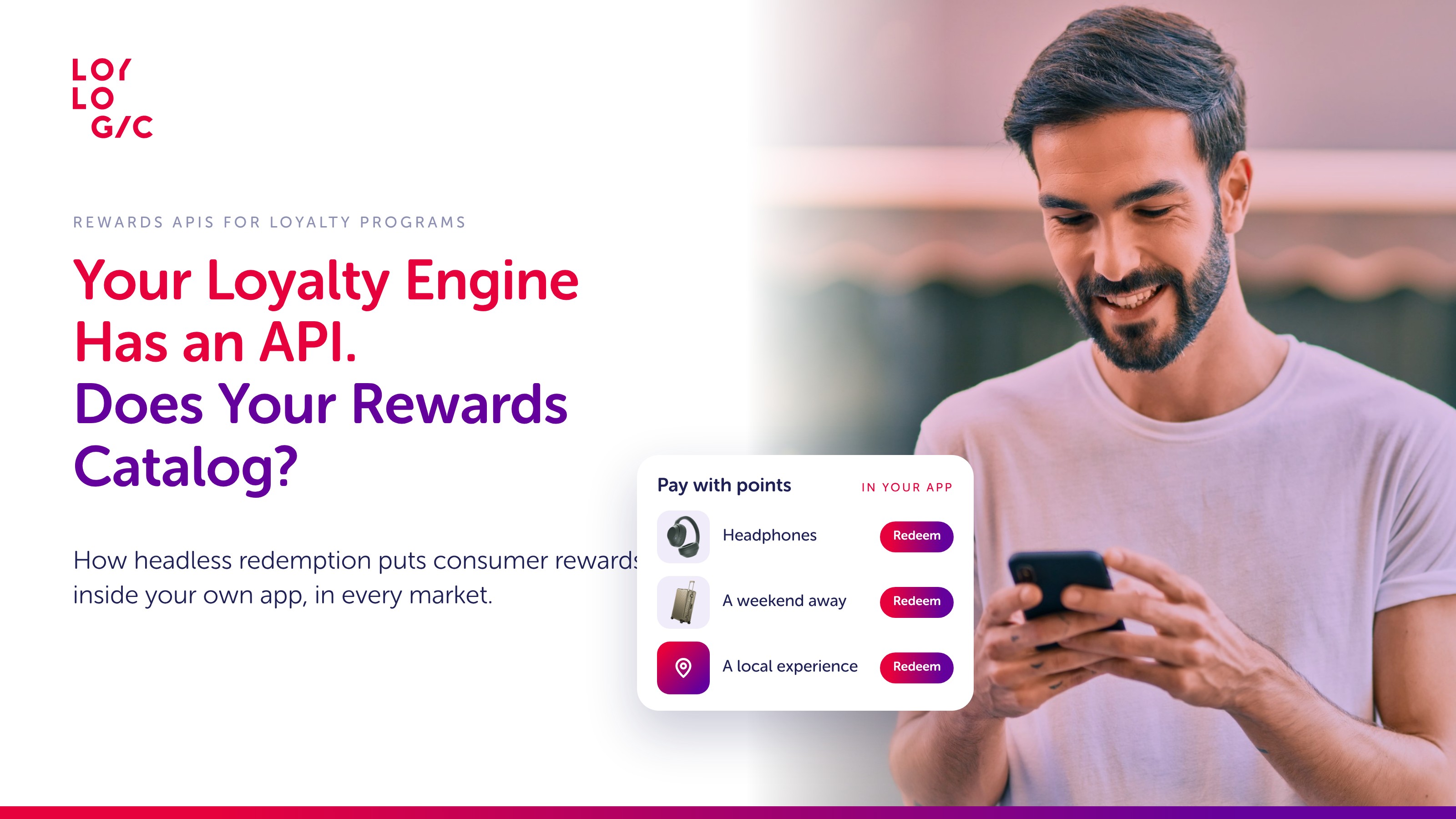
Your Loyalty Engine Has an API. But Does Your Rewards Catalog?
A rewards API gives a loyalty platform, app or agency stack a full redemption layer through one integration: a catalog of rewards, live pricing in points, checkout, and fulfillment across markets.
Insights & Thought Leadership
Oct 8, 2026
12
min
Most Loyalty Reward Catalogues Fail to Drive Repeat Custom: Here’s What Providers Can Do About It
Every loyalty agency and platform provider has had this conversation with a client. The program is enrolling members, the tech is working fine, and all the dashboards look healthy. Yet this still isn't translating into the repeat customer behavior everyone promised.
Insights & Thought Leadership
Accelerate your growth through our rewarding experiences
Get in touch for a personalized demo and see how our reward solutions can help your business grow.